Showing posts with label In which Our Hero was dumb. Show all posts

Wednesday, September 17, 2014

Sunny Day at the Imperial Palace

Hi everybody,

It appears to be my fate in life to visit the Imperial Palace when the gardens are closed.  Alas, perhaps I should just accept it

It's actually very common for museum or other sites of interest to be closed on Mondays and Fridays.  Why this is, we can all speculate with equal ignorance.  I learned this fact the last time I tried to visit the Imperial Gardens, when I was here last year.  So this time, I came prepared, or at least I came on a Tuesday.  Only to remember that when Monday is a National Holiday, such as yesterday which was National Respect Your Elders Day (no seriously, did everyone remember to respect an elder?) the museum/gardens/whatever are open for the holiday but closed the next day.  Foiled again!

That's ok, I still got a few pictures :D

One of the main gates, shuttered for the day
If I were a swan, I'd pick the Imperial Moat to live in as well
A popular path for joggers--the perimeter of the moat is almost exactly five kilometers (sixteen foot-pounds, I believe)
But seriously, that's a hell of a moat
Speaking of moat.  Now, I'm a big fan of the moat as an architectural feature, but I accept that in today's day and age it's out of reach for all but the most luxurious of homes (reason #35,266 why I hate Tom Brady.  It has koi in it!  Ugh I hate that man).  But the funny part is that, for the Imperial Palace, the addition of the moat has about as much practical use as Brady.  More serious students of Japanese history can correct me if I'm wrong, but as far as I know no one has ever attacked the Imperial Palace.  No one has ever even considered it in the millennia that the Emperor has existed (and yes, I know that this particular edifice has only been the Imperial Residence for like a century and a half, I'm speaking in broader terms)

There has been civil war many, many times, but ever since its establishment over two and a half millenia ago, the Emperor has almost always stood above.  When the warlords fought across Japan, it was only to have the right to be acknowledged as the sovereign military ruler by the Emperor

This is not to say that the Emperor has always ruled supreme, quite the opposite.  There have been centuries-long eras in which the Emperor was little more than a figurehead besi the Shogun, or military leader, of Japan.  And yet, even if that acknowledgment was a mere formality because the Emperor would have been a fool to withhold it, the Shogun still needed the endorsement of the Emperor  (Portuguese missionaries once described the Emperor and Shogun as similar to the Pope and the Holy Roman Emperor, if you want a Western analogy)

In fact, the comparison to the Pope is a solid one--no matter how much we fight beneath him, only the truly godless Muslims or Mongols (in this analogy, the Chinese or Americans I suppose) would ever actually attack the Pope.  He's, you know, the Pope

Anyways, my point is that it seems kind of silly to have such a strictly defensive structure as a moat around a building that pretty much every warrior in all of Japan would die before allowing to be attacked.  But hey, I'm not complaining.  As discussed above, I like moats!

Plus, I assume that in a time of National Emergency this dude would come to life and defeat any invading armies merely by glaring at them
Noah out

Thursday, August 28, 2014

On Translation, the Importance of

Hi guys,

Quick story time.  My Japanese, while not great, is not that terrible.  However, every so often I manage to mess things up because I don't even bother trying to use my Japanese.  I am not a clever man.  Let me illustrate:

I'll start the story off by explaining that I try to avoid literal translation whenever possible.  A while ago, I came across the theory that translation is the enemy of true fluency; the idea being that you shouldn't translate a Japanese word into an English word and then think about the concept expressed, you should simply jump straight from the Japanese to the concept.  For instance, when I learn the word れいぞく(reizoku) I try to teach myself that it means "the magic silver box in which we put food after dinner and then immediately take it out in a few hours for a midnight snack"--instead of teaching myself that れいぞく means "refrigerator" which in turn means "the magic silver etc. etc."

(This approach is even more meritorious when dealing with things like names.  It's not particularly helpful to think of my friend as "Mr. Bamboo Field", I think I'll be served just as well by remembering his name as "Mr. Takeda")

This concept of translation is further complicated by the fact that, for the purposes of this discussion, Japanese uses two different written languages
[Editor's note: This entire paragraph is grossly inaccurate, leaves a lot of things out, and is such an oversimplification that it has more or less crossed over into falsehood; those of you that actually know Japanese, we appreciate your bearing with us for the purposes of the story.  Actually, if you do know Japanese you can skip right to making fun of the author because you'll figure out the punchline pretty quickly]
The first language, Hiragana, is phonetic--each character represents a syllable.  The second language, Kanji, is used to convey meaning--each character represents a word, thought, or concept.  Thus, each kanji has a "reading" that you sound out using hiragana characters.  This is further complicated by the fact that kanji has a number of homophones.  In essence, the mapping is not one-to-one: While each kanji has a single reading in hiragana [Ed: *cringe*], a given string of hiragana characters could have multiple representations in kanji, meaning a given string of hiragana characters could have multiple meanings


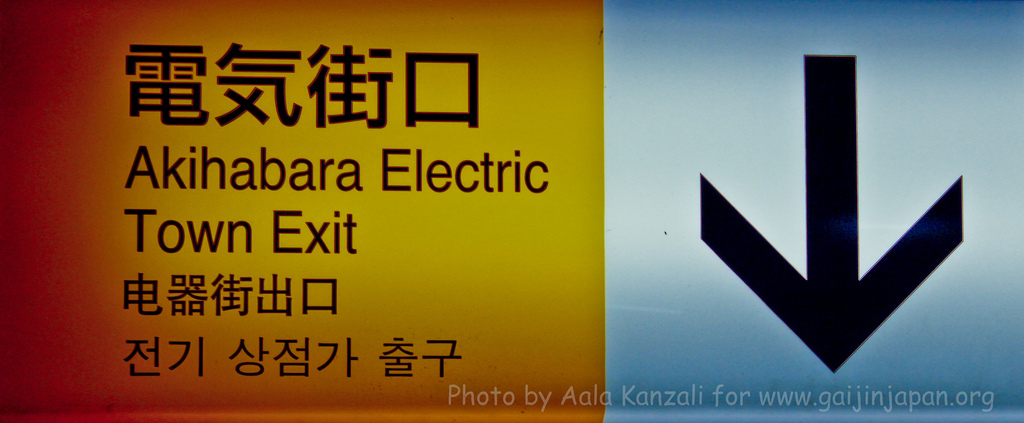
Thus, when I saw that I would have to take the "Denkigai Exit" at Akihabara Station in order to make my lunch date, I didn't bother translating this word because a) translating is not my habit, especially not for proper nouns and b) unless you already know the word it's difficult to translate without seeing the word's kanji representation

The problem was that when I got to the station and didn't see a single sign for a "Denkigai Exit".  There's the Central Exit, the South Exit, no not those . . . the only one left was the "Akihabara Electric Town Exit", that's not it either . . . what the hell is going on here?  Where is "Denkigai Exit"???

Up stairs, down stairs, turn left, turn right, I know I've already been this way . . . at this point I'd been wandering around the station for a good five-ten minutes trying to find this elusive Denkigai Exit.  I say five-ten because I'm estimating downward from the fifty minutes it felt like as I moved from amused to annoyed to confused to bewildered to truly frustrated to seriously stressed because I didn't want to be late for lunch.  Finally, my eyes just happened to glance over the Japanese writing on an exit sign . .
Photo courtesy of--oh wait, you guys can read it yourself
See, they gave me the English translation, so silly ol' me didn't even bother looking at the Japanese.  It was merely by chance that I noticed the character 電, which is pronounced den, at which point the following train of thought went through my head in about a half a second:

"Gee, the word 'Denkigai', whose meaning I never actually bothered to translate because I am lazy
". . . could probably be written as 電気街
". . . which would mean something along the lines of 'Electricity District'
"And hey, there are those same three kanji right there on one of the dozen of signs I've walked past in the last few minutes . . .
". . . plus the 口 character which of course just an abbreviation for "exit"
"So that means that the dozens of signs for for "電気街口 Electric Town Exit" . . .
". . . past which I have breezed in an increasingly angry manner while looking for "Denkigai Exit" . . .
". . . probably mean . . .
". . . huh
". . . yup
". . . well
". . . now I feel like an idiot"

Moral of the story:  Dude, Noah, at least make an attempt not to wander back and forth around the train station like a dumb tourist.  Just try, yeah?  Can you do that for us?  Just try?

Made it to lunch with just barely a minute to spare :P

Noah out